September 7, 2026

12
min read

"The auditor's on their way. Pull up the updated risk matrix." "It's on the vibe-coded server somewhere. The AI doesn't remember where it saved the link."
That's not a joke. That's what happens when a medical device company takes the hottest trend in software development – vibe coding – and points it at one of the most regulated categories in the world.
It usually starts with a founder who wants to save money or an R&D manager who's tired of paying for external tools. The pitch sounds like this: "Why bring in an external eQMS or ALM platform? Let's build our own with AI over a weekend. It'll fit exactly what we need."
For a small software company building a file-storage app, that pitch might actually work.
For a company building medical devices, pharma products, aerospace hardware, or automotive systems – companies answerable to the FDA, EU MDR, or ISO 13485 – it's a different conversation entirely.
A real quality system for a regulated device isn't a tool. It's the infrastructure that determines whether you pass your next audit or shut down the business. That infrastructure has to carry:
Build that yourself, and you haven't saved money. You've turned your medical device company into a software company that now has to develop and maintain its own eQMS indefinitely.
Every bug in the AI-generated code is now your team's problem. Every regulatory update requires new development work. And every audit question – "Where's the change documentation for this ECO?" – lands on your desk, not a vendor's.
The most expensive part: your best R&D engineers start spending their time on document control and traceability features instead of the product that actually generates revenue and, for a lot of these companies, keeps people alive.
Some companies that swap out proven tools for an internally vibe-coded system will get through the first few weeks fine. It's the first serious pre-audit where the picture changes – and where most teams realize they need a system built by a company with the track record, the domain knowledge, and the ongoing investment to keep a platform like this genuinely sustainable.
That "free" weekend build tends to get expensive fast: a delayed FDA clearance, months of remediation after a failed audit, and – before any of that – the validation time, token costs, and data security work nobody accounted for on day one.
Some platforms on the market were built to help you pass your first audit as a startup. A system you vibe-coded over a weekend probably won't survive the first hour of your second one.
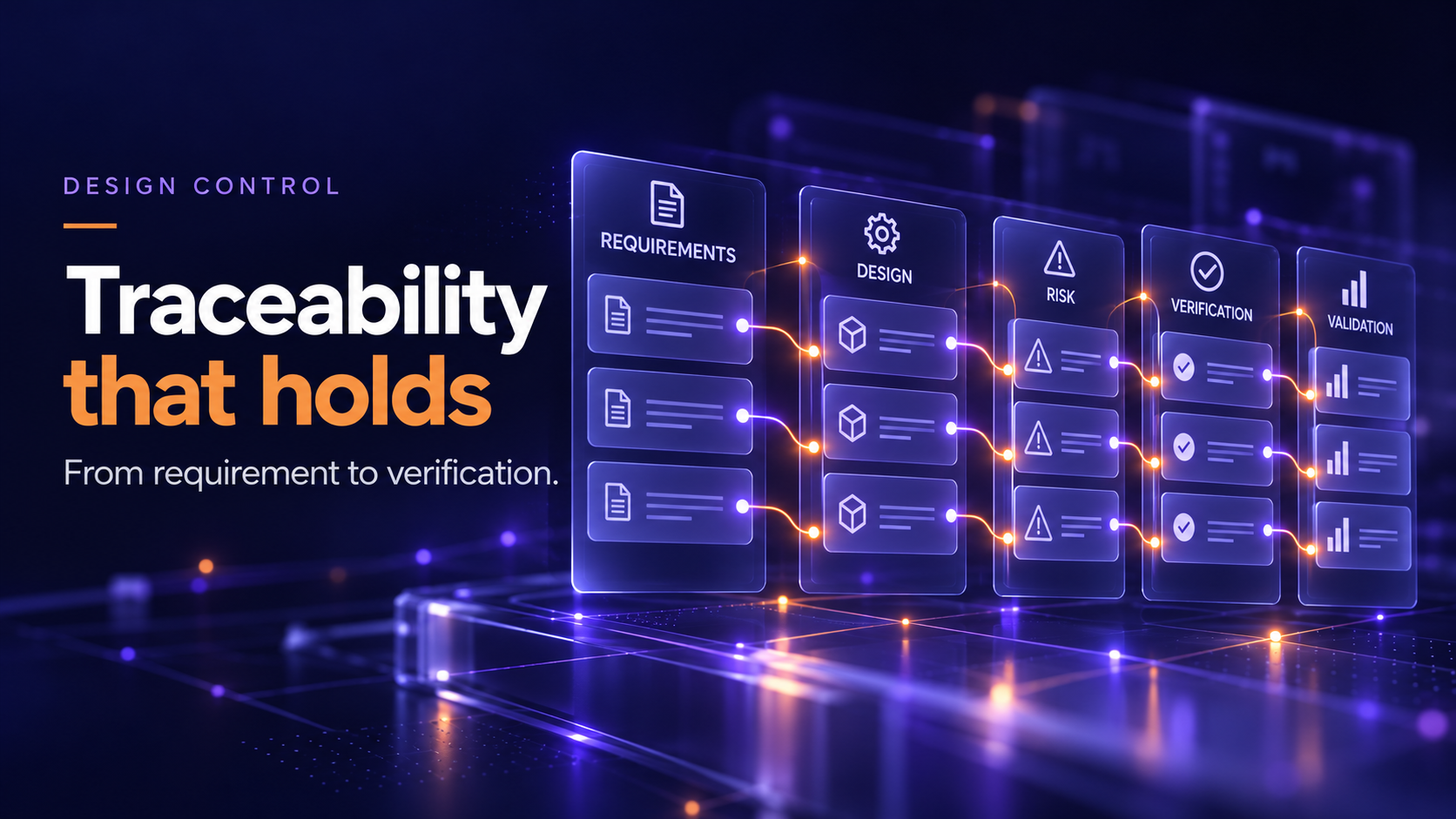
Regulation isn't a "half-built" environment. DHF requirements don't write themselves, CAPAs don't close themselves over email threads, and one broken link between a requirement and a test can cost you months with a Notified Body.
Some platforms were built for your first audit. Orcanos was built for every audit after that.
At Orcanos, engineering and quality live under one roof – natively connected – so you're not stuck choosing between rigid off-the-shelf software and a system your own team has to build and maintain from scratch. When the auditor shows up, there's no scramble for evidence, no lost spreadsheets, and no need to explain why traceability is currently managed in a prompt history. You just let them look.
Next time someone on your team proposes, "We'll just build our own QMS in a couple of weeks," ask them one question: Are you the one sitting in the back room with the FDA auditor, explaining why your traceability matrix lives inside a chat log?
Built for medical devices. Built to fit you. Orcanos unifies Quality, R&D, documentation, and risk into one connected platform, purpose-built for medical device companies and shaped around how your team actually works. Not a shell you climb into. A system built around you.