November 19, 2026

8
min read
The ISO 9001 revision cycle is underway, and the draft direction is clear enough that QMS teams in medical devices should be thinking about it now. Here is what the current drafts signal, how the changes interact with ISO 13485 and the FDA's Quality Management System Regulation (QMSR), and where you will likely need to update your system.
ISO 9001 revisions follow a roughly ten-year cycle. The 2015 version introduced the Annex SL high-level structure, context of the organization, and risk-based thinking. The 2026 revision, still in draft at time of writing, builds on those foundations. Three themes stand out from the published committee drafts.
The 2015 standard asked organizations to understand their context and the needs of interested parties (Clause 4.1 and 4.2). The 2026 drafts expand this to include resilience planning: the ability to absorb disruption and maintain quality outputs. For medical device teams, this overlaps with existing supply chain risk requirements under ISO 13485:2016 Clause 7.4 and the QMSR's incorporation of those obligations. Resilience thinking may need to be documented at the organizational level, extending beyond the product or supplier level where most teams already address it.
ISO is aligning 9001 with its broader sustainability commitments. The draft includes an explicit prompt to consider climate-related risks when establishing organizational context. For most medical device manufacturers, this is not a large operational leap. If you already maintain an environmental aspect register or align with ISO 14001, the evidence base exists. The gap, for most teams, is connecting climate-related risk considerations to the QMS context document rather than keeping them in a separate environmental management system.
The 2015 revision replaced "documents and records" with "documented information," but left implementation largely technology-neutral. The 2026 drafts go further in acknowledging that quality processes are increasingly automated and data-driven. Expectations around data integrity, system controls, and the trustworthiness of digitally generated records are coming into sharper focus. This directly intersects with 21 CFR Part 11 for FDA-regulated teams: electronic records must be attributable, legible, contemporaneous, original, and accurate, whether the source is a paper form or an automated system output.
ISO 9001 and ISO 13485 are related but independent standards. ISO 13485:2016 intentionally diverged from ISO 9001:2015 in several areas to reflect the stricter requirements of medical device regulation. A revision to 9001 does not automatically revise 13485.
What it does do is create expectation drift. Auditors trained in the latest 9001 thinking bring those concepts into 13485 audits, even when the clause text does not require them yet. If a notified body auditor asks how your QMS addresses organizational resilience and your context analysis was written in 2017, that conversation will be uncomfortable even if it is technically outside scope.
The more direct regulatory pressure right now is the QMSR, which has been in force since 2 February 2026 and incorporates ISO 13485:2016 by reference. If your design controls and medical device quality management system have not been updated to reflect the QMSR's framing, that is a more immediate gap than the 9001 revision.
The documented information and digital process themes are where the gap between intent and practice is widest for most teams. Consider what a 9001:2026 audit question on digital process integrity might expose:
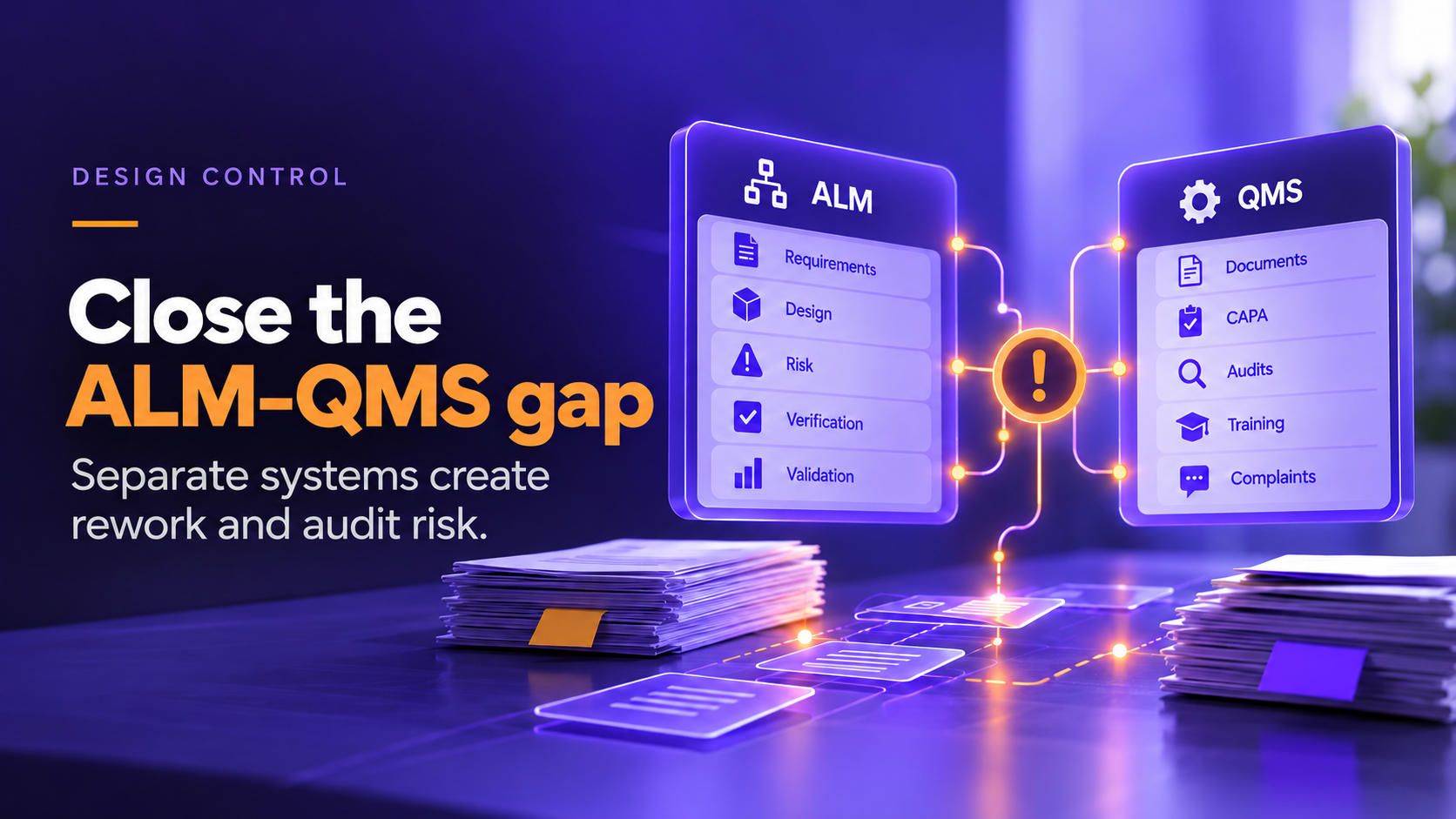
These are not hypothetical. They are the conditions that separate ALM and QMS tools create in most mid-sized device companies. Each system maintains its own record. The connection between them lives in a person's head or a manually maintained spreadsheet.
The 2026 revision frames the expectation around system-level data integrity in terms auditors can point to, making these gaps harder to explain away.
You do not need to wait for the final ISO 9001:2026 publication to act on what the drafts make clear.
The documented information expectations in the 2026 drafts are easiest to meet when development and quality records share a common data model. When requirements, risk records, test results, nonconformances, and CAPAs are managed in the same system, the audit trail connecting them is a system property, produced automatically as work is done.
Orcanos links requirements management to risk records, design outputs, and CAPA management in a single traceability structure. When a nonconformance is opened, the connection back to the affected requirement and its risk assessment is already there. That is the kind of documented information integrity the 2026 revision is pointing toward.
If your current setup has QMS records in one tool and development records in another, the question is whether you will close that gap before or after it surfaces in an audit.
Talk to the Orcanos team about how the platform maps to your current QMS structure: meet our experts.