October 15, 2026

28
min read
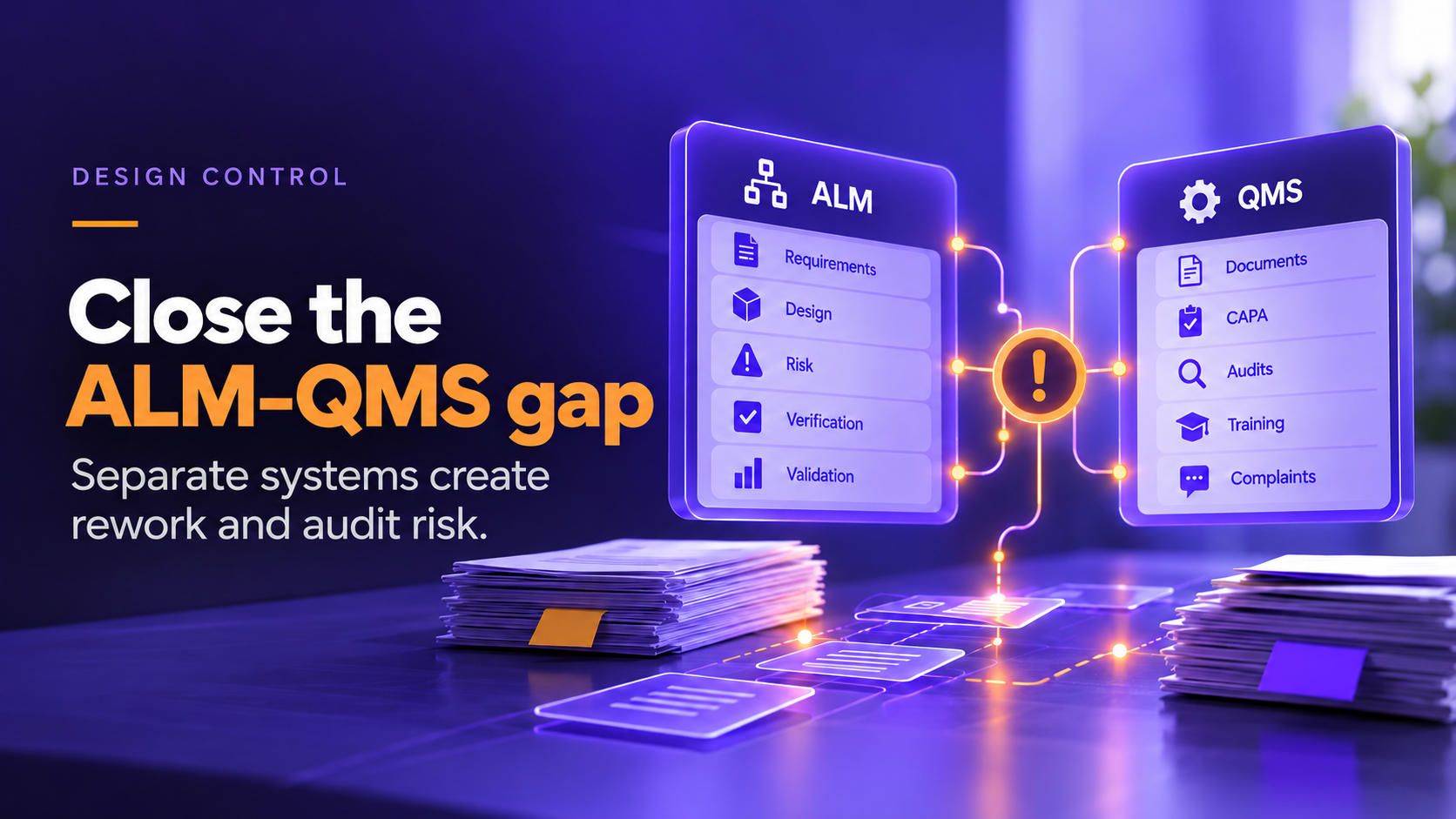
If your design engineers work in one tool and your QA team works in another, you already know the problem. Someone has to bridge those two worlds by hand. In medical device development, that manual bridge is exactly where compliance risk lives.
It usually shows up the same way. An audit is three weeks out, and a senior engineer stops product work to rebuild a traceability matrix in Excel. Or a CAPA stays open for months because nobody can quickly confirm whether a complaint traces back to a design input or a manufacturing issue.
This article explains where split ALM and QMS tools create audit exposure, rework, and schedule delays, what regulators actually expect, and what changes when design control and quality live in one connected system.
The split rarely starts as a strategy. R&D picks a requirements or ALM tool because it handles user needs, software requirements, and design verification well. QA picks an eQMS because it manages document control, CAPA, complaints, and training. Each team chose the best tool for its own job.
The trouble is that each choice was made in isolation. Nobody owned the space between the two systems, so that space gets filled with exports, spreadsheets, and the memory of whoever has been around longest.
The regulations do not recognize the line between your R&D tool and your QA tool. They treat design control and quality management as one process.
ISO 13485:2016 Clause 7.3 requires a traceable, demonstrable connection between design inputs, design outputs, verification, validation, and design changes across the device lifecycle. ISO 14971 adds that every risk control must be implemented and verified, which means risk records have to point to real requirements and real test evidence.
In the US, this is now one conversation instead of two. FDA's Quality Management System Regulation (QMSR) took effect on February 2, 2026 and incorporates ISO 13485:2016 by reference into 21 CFR Part 820. FDA investigators are now assessing your design controls against the same clauses a notified body uses.
None of this says you must use one tool. It does mean that when records live in separate systems, compliance is not something your system shows. It is an argument your team has to make, by hand, every time an auditor asks a traceability question.
In a split environment, the traceability matrix does not exist until someone builds it. They pull requirements from the ALM tool, match them to risk controls in a separate risk file, map those to verification and validation evidence, and format it all so the QMS can reference it.
That work repeats at every design review, every design change, and every audit prep. QA teams we talk to commonly describe two to four weeks of engineering and QA time spent assembling traceability before a major audit or submission. That is not compliance work. It is rework created by tool architecture.
This is the failure mode with the most regulatory exposure. A software requirement changes, and the engineer updates it in the ALM tool. The related risk control, the verification protocol that covered the old requirement, and the design review that approved it all sit in other systems with no live link.
ISO 13485 Clause 7.3.9 requires you to assess the effect of each change on product already delivered and on approved design documentation. If your tools are not connected, that assessment depends on someone remembering to check. Auditors know this, so they pick a change record and trace it forward and backward through your DHF.
A CAPA system that cannot see design records ends up treating symptoms. A complaint comes in, a CAPA opens, and the investigator has to request specs, risk records, and test data from another team just to decide whether this is a design issue or a manufacturing variance.
That delay is where misclassification happens. If the real root cause is a design input that was never adequately validated, and your QMS has no direct path to that record, your corrective action will not meet Clause 8.5.2. You fix the symptom and leave the cause in place.
The Design History File is supposed to be a living record you can show at any point. When it is stitched together from an ALM tool, a risk spreadsheet, a document system, and an eQMS, it turns into a compilation project before every release and every audit.
Teams spend hours confirming that versions match, approvals are current, and the QMS reflects what engineering actually built. None of that makes the device safer.
Every tool that holds regulated records has to be validated and has to meet 21 CFR Part 11 expectations for electronic records and signatures. Two tools means two validation packages, two upgrade cycles to revalidate, and two audit trails. When an investigator asks who approved a change and when, the answer may be split across both.
FDA investigators and notified body auditors are good at spotting systems that look compliant on paper but are fragile in practice. A common move is to pick one item, such as a complaint, a requirement, or a design change, and ask you to walk it end to end while they watch.
If answering one question means switching between three tools, opening exports, and matching document IDs by hand, the auditor learns something about your QMS that no procedure can fix. What they want to see is a system that is maintained continuously, not reassembled whenever someone looks at it.
Try these five questions with your team. If more than one answer is "it depends" or "let me get back to you," your tool architecture is costing you more than it should.
When requirements, risk, verification, validation, and CAPA share one platform with enforced links, compliance becomes a property of the system rather than a task your team performs. In practice, four things change.
Traceability is live. A requirement created by engineering is immediately visible to risk management. A risk control links directly to the requirement it addresses and to the test that verifies it. There is no export and no reconciliation step.
Design changes show their impact up front. When someone edits a requirement, the platform surfaces every linked risk entry, test protocol, and approval. The change owner sees the full scope before the change is made, not after an auditor finds the gap.
CAPA starts with full context. The quality team opens an investigation and sees the relevant requirements, risk controls, and validation records in the same place. Root cause analysis gets faster and more accurate because nothing has to be requested from another team.
The DHF is always current. Because every record is linked and versioned in one place, your DHF builds itself as work happens. Audit prep stops being a project.
Orcanos is a combined ALM and eQMS platform built for medical devices. It is not a QMS with a requirements module bolted on, and it is not an ALM tool with a few quality forms added. Requirements, design controls, risk management, CAPA, and DHF records share one data model, with traceability enforced at the architecture level.
That matters to both sides of the split. For R&D, engineering is home: requirements, risk, and testing work the way engineers actually work, without forcing them into a document-control mindset. For QA, every record engineering creates is already linked, versioned, and audit-ready. And because no two device companies run the same process, Orcanos is built for medical devices and built to fit you, configurable to your workflows rather than the other way around.
Companies including GE Healthcare, Medtronic, and Covaris use Orcanos to manage the full development and quality lifecycle in one place. The result is what the regulations have always asked for: a single audit trail from user need to post-market quality event.
If your team spends weeks assembling traceability, chasing design change impacts across systems, or reconciling the DHF before every audit, that effort is not a compliance tax. It is the cost of the wrong tool architecture. The regulations have always expected design and quality to work as one system. The real question is whether your tools support that or work against it.
Want to see it with your own data? Book a demo with the Orcanos team and bring your toughest traceability challenge. We will show you exactly how it maps.
ALM (application lifecycle management) covers how a device is designed and built: requirements, design, risk analysis, and verification. A QMS (quality management system) covers how quality is controlled across the company: document control, CAPA, complaints, training, and audits. ISO 13485 expects the two to be connected through design controls.
No. ISO 13485 requires traceability and controlled design changes, not a specific tool. But when design and quality records live in separate systems, you have to prove that traceability manually, which is where most findings and delays come from.
Since February 2, 2026, FDA's QMSR incorporates ISO 13485:2016 into 21 CFR Part 820. US and international audits now look at design controls through largely the same clauses, so gaps in traceability tend to surface in both.
Teams using separate ALM and QMS tools often report two to four weeks of combined engineering and QA effort before a major audit or submission. With an integrated platform, the matrix is generated from live links and is available on demand.