November 25, 2026

23
min read
FDA's November 2024 FAQ update confirmed what many QA teams suspected: investigators conducting QMSR inspections are not limited to records created on or after February 2, 2026. Pre-transition records are fair game, and the agency has told you exactly what it expects to see when they are reviewed.
FDA issued an updated FAQ on November 5 addressing how investigators should handle QMS records that predate the QMSR transition. The core guidance is straightforward and worth reading carefully.
Investigators are not restricted to records created after February 2, 2026. If your last management review was in October 2025, it is inspectable. If your most recent internal audit closed in December 2024, it is inspectable. The transition date marks when QMSR became the governing regulation; records created before it remain within an investigator's reach.
FDA recommends that manufacturers be prepared to present a comparative analysis showing that pre-transition records meet QMSR requirements. This is not a formal submission requirement. It is practical preparation: if an investigator pulls a 2024 CAPA and asks whether it satisfies the QMSR's ISO 13485:2016 Clause 8.5.2 framework, you need a defensible answer ready before the inspection.
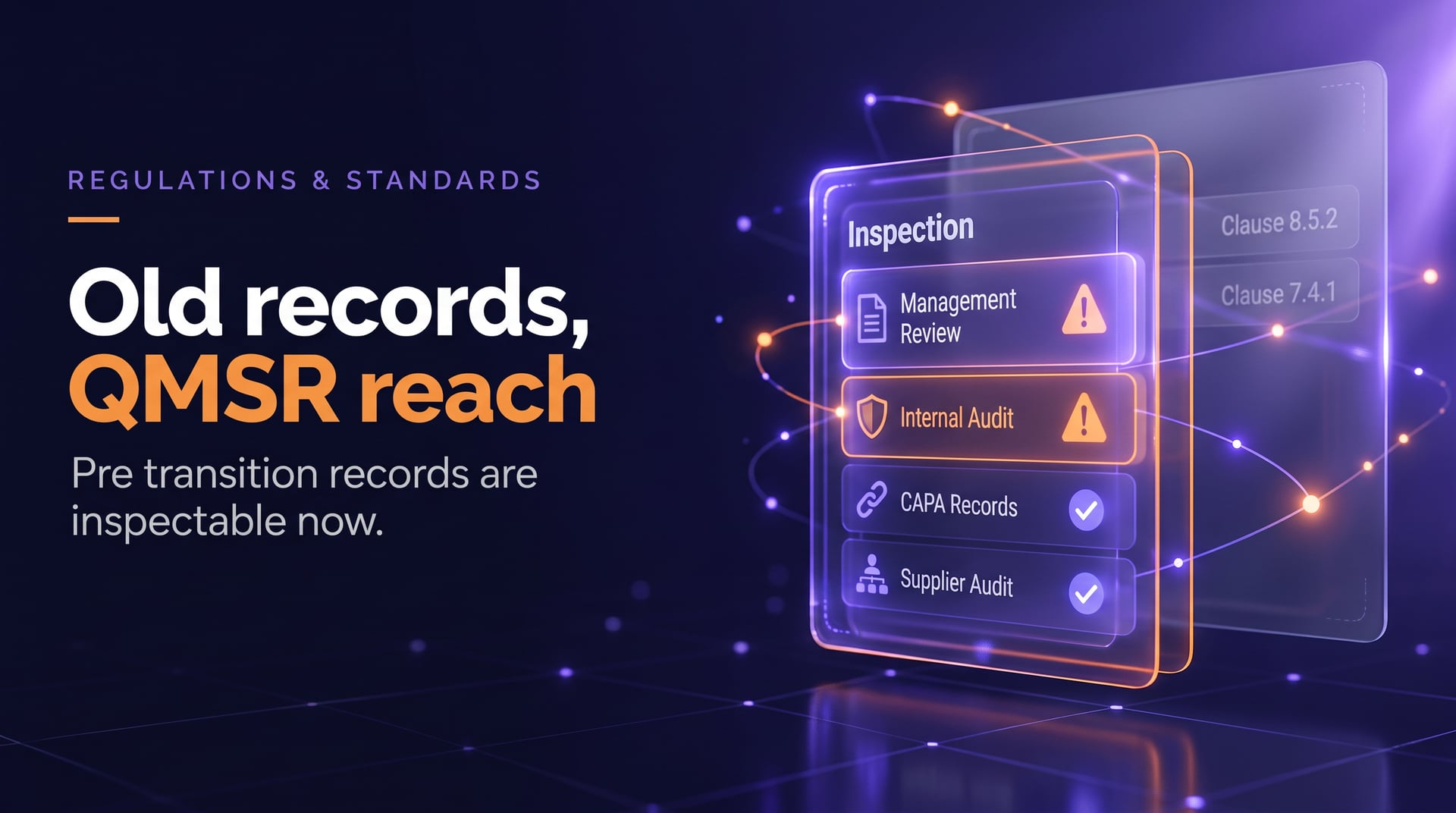
The FAQ specifically flags internal audit reports, supplier audit records, and management review reports as records investigators will want to access. These three record types are consistent ISO 13485 pressure points, and the FAQ makes clear they remain so across the transition.
The practical risk here is not that your 2024 records are substantively deficient. Most QA teams running a mature ISO 13485 program were already aligned with the QMSR's requirements, because the QMSR incorporates ISO 13485:2016 by reference. The risk is that your records were created in a documentation environment that did not require QMSR-style traceability, and that gap shows under inspection.
Consider three common scenarios.
The management review report with no downstream links. Your December 2025 management review summarized CAPA status, audit findings, and complaint trends. It is a solid document. But if the reviewer cannot follow a link from that summary to the individual CAPA records, the risk items discussed, and the design inputs they affect, the traceability an investigator expects is absent. The document exists; the audit trail does not.
The supplier audit that lives in a folder. ISO 13485:2016 Clause 7.4.1 requires documented criteria for supplier evaluation and records of re-evaluation. If your supplier audit reports are PDFs in a shared drive with no connection to your approved supplier list, your incoming inspection records, or your CAPA history for that supplier, an investigator has to take your word that the program is coherent. That is a weak position.
The CAPA closed before the transition. A CAPA opened in 2023 and closed in 2024 may have been perfectly executed under the previous framework. Under QMSR review, the investigator will apply ISO 13485:2016 Clause 8.5.2 criteria: Was the problem investigated to its root cause? Were actions verified for effectiveness? Is there evidence that the corrective action did not introduce new risk? If your CAPA records were built in a system that treated CAPA as a form workflow, some of those questions will be hard to answer from the record alone.
FDA's recommendation of a comparative analysis is practical advice. The analysis needs to do three things.
Map your legacy record structure to QMSR clause requirements. For each major record type (internal audits, management reviews, CAPA, supplier qualification, design controls), document which QMSR clause governs it and confirm that the record content satisfies the clause. This does not require recreating records. It requires a written rationale, ideally reviewed and approved by QA leadership before an inspection.
Identify gaps and document their disposition. If a 2024 internal audit report does not include a documented procedure for follow-up actions (ISO 13485:2016 Clause 8.2.4 requires this), acknowledge it, assess the materiality, and document what compensating controls or subsequent records address it. An investigator who finds a gap you have already acknowledged and addressed is in a very different conversation than one who finds a gap you missed.
Demonstrate continuity from legacy records to current state. The comparative analysis should show that design decisions made before February 2026 are carried forward in your current design history file, that risk records are updated and not frozen in a 2023 snapshot, and that CAPA trends are tracked across the transition, not reset at it.
Based on the FAQ guidance and standard QMSR inspection patterns, prepare these record sets first.
| Record Type | Governing Clause | Common Inspection Question |
|---|---|---|
| Internal audit reports | ISO 13485:2016 Clause 8.2.4 | Is there evidence of follow-up and closure? |
| Supplier audit records | ISO 13485:2016 Clause 7.4.1 | Are re-evaluation criteria documented and applied? |
| Management review reports | ISO 13485:2016 Clause 5.6 | Do inputs cover the required elements? Are outputs tracked? |
| CAPA records | ISO 13485:2016 Clause 8.5.2 | Is root cause documented? Is effectiveness verified? |
| Design control records (DHF) | ISO 13485:2016 Clause 7.3 | Is the traceability chain from input to verification complete? |
The FDA FAQ puts a spotlight on something that separate ALM and QMS tools make structurally difficult: demonstrating that records created at different times, in different systems, by different teams, form a coherent and traceable quality record.
If your design controls live in a requirements tool, your risk file is a Word document last updated by an engineer who has since moved on, your CAPA is managed in a quality management system that does not link to design artifacts, and your internal audit records are PDFs attached to email threads, then producing a comparative analysis becomes a manual reconstruction project. Under inspection conditions, that is exactly the kind of exercise that reveals gaps you did not know you had.
This is where having design controls, risk management, and CAPA records connected within a single data model changes the nature of the problem. In Orcanos, a requirement links to its associated risk items, to the test evidence that verifies it, and to any CAPA or nonconformance that has affected it. When an investigator asks whether a 2024 design decision was reviewed in the context of subsequent risk updates, the answer is traceable from a single record. The comparative analysis FDA recommends becomes a reporting exercise, because the connections between records were built as the work was done.
Pre-transition records are part of your QMSR compliance story whether you document that or not. The manufacturers who come through inspections cleanly are the ones who decided not to treat February 2, 2026 as a reset.
If you want to see how connected requirements traceability and quality records change how your team prepares for and responds to inspections, talk to the Orcanos team about what your current record structure would look like under QMSR review.