October 26, 2026

35
min read
ISO 13485:2016 does not use the term "traceability matrix" once. That matters, because teams sometimes treat the matrix as the requirement rather than as evidence of meeting it.
The actual requirement is distributed across Clause 7.3 (Design and Development) and supported by Clause 4.2.4 (Control of Documents), Clause 4.2.5 (Control of Records), and Clause 7.1, which requires risk management throughout product realization. Read together, they require that you can demonstrate:
What this means in practice: every requirement must have a traceable path forward to its design output, verification test, validation evidence, and any associated risk control. Every risk control must trace back to the requirement it protects. If any link in that chain is broken or undocumented, you have a gap an auditor can and will find.
For a deeper walkthrough of the full ISO 13485 compliance framework, see the Complete Guide to ISO 13485 Compliance for Medical Device Manufacturers.
Most medical device teams do not start with the intention of building disconnected systems. They start with a requirements tool that works for engineering, then add a QMS platform for quality records, and then discover that these two systems have no shared data model.
Here is where the breakage typically occurs:
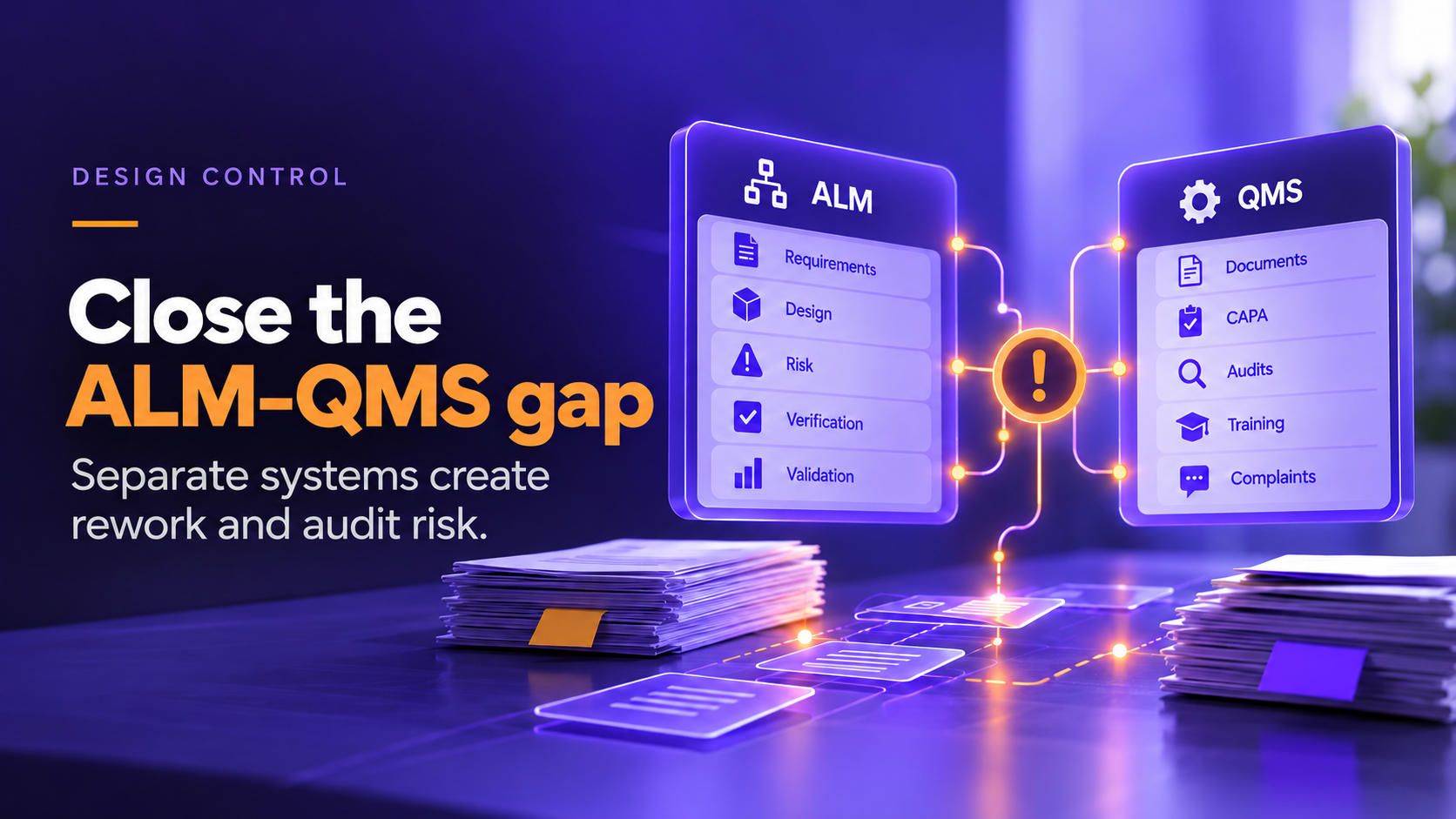
Requirements live in the ALM tool. Engineers write and manage specifications, link tests, and track verification in Jira, DOORS, or a similar platform. The engineering team considers this their source of truth.
Quality records live in the QMS. CAPAs, risk assessments, DHF documentation, and change control records are managed in a separate QMS platform. The quality team considers this their source of truth.
Neither system knows the other exists. When a requirement changes in the ALM tool, the QMS does not update. When a CAPA identifies a design gap, the requirements tool does not reflect it. The traceability matrix, if one exists, becomes a snapshot of a moment that has already passed.
The practical consequence: at the time of an audit, neither system alone tells the complete story. The team must pull data from both, reconcile discrepancies, and explain inconsistencies to an auditor who has seen this pattern many times before.
This is not a process failure. It is an architectural one. Separate systems create compliance gaps not because teams are careless, but because the tools were never designed to share a traceability model.
The gap between disconnected systems does not go unmanaged. Teams fill it with manual effort, typically a combination of the following:
Spreadsheet-based traceability matrices. A QA engineer, or sometimes a regulatory affairs manager, manually constructs a matrix that maps requirements to design outputs, tests, and risk items by pulling data from each system and assembling it in Excel. This is often a multi-day effort before any audit.
Scheduled exports and reconciliation. Some teams set a cadence, monthly or quarterly, for exporting data from the ALM tool and comparing it against QMS records. Any delta must be investigated and explained. If the cadence slips, the matrix drifts.
Email and document trails as audit evidence. When a formal link does not exist between systems, teams substitute email chains, meeting minutes, and manually updated Word documents to demonstrate that a connection was made. This evidence is difficult to navigate during an audit and even harder to defend if questioned.
Dedicated "traceability owner" roles. In some organizations, one person effectively serves as the human integration layer, manually maintaining the mapping between engineering records and quality records. When that person leaves, institutional traceability knowledge leaves with them.
The cost of this manual work is not just labor hours. It is the risk of error. Version mismatches, missing links, and outdated cross-references are common. Auditors do not accept the explanation that the matrix was current last month.
For a detailed look at building a defensible traceability matrix structure, see the Requirements Traceability Matrix for Medical Devices: A Complete Compliance Guide.
An experienced auditor does not review a traceability matrix to confirm that it exists. They use it as a starting point to probe whether your design controls are real.
Specific checks auditors routinely run:
Where teams most commonly fail: the matrix is complete at the input/output level but does not show risk control linkage, or it reflects a prior version of the device because the update process was not triggered when a change was approved.
When requirements, design outputs, test records, risk items, and quality records share a single data model, traceability is not assembled. It is generated.
In a genuinely integrated ALM and QMS platform:
This is not a marginal improvement in efficiency. It is a different compliance posture. The evidence exists continuously, not only when someone builds it.
For a detailed breakdown of how design controls function within this kind of integrated environment, see the Medical Device Design Controls guide.
Orcanos is built specifically for this model. It is the only platform that links requirements, design outputs, verification and validation records, risk items, and CAPA in a single audit trail, eliminating the integration problem that arises when ALM and QMS operate as separate systems. QMS-only platforms manage quality records without engineering context. Standalone requirements tools manage specifications without quality linkage. Orcanos gives both teams a shared system, so the traceability chain is never broken by a tool boundary.
Before your next audit, run this self-check with your team:
If any of these checks surface a problem, the corrective action is not another spreadsheet. It is an architectural change: consolidating requirements, design controls, and quality records into a system designed to keep them in sync.
See how Orcanos connects requirements, risk records, and quality evidence in a single traceable system. Schedule a demo to assess your current traceability architecture.
Forward traceability follows requirements downstream: from user needs to design inputs, design outputs, verification tests, and validation evidence. Backward traceability reverses the direction, confirming that every test, output, and design element links back to a documented requirement. A complete traceability matrix must support both directions. Auditors use backward traceability specifically to identify orphaned design features that have no requirement justification.
Both teams own it, at different levels. Engineering owns the linkage between requirements and design outputs. Quality owns the linkage between design records and the QMS, including risk controls, CAPA, and DHF compilation. The practical problem is that ownership split is where traceability breaks when tools are separate. In an integrated system, both teams work in the same traceability model, so ownership is collaborative rather than sequential.
It should be reviewed as a required output of every design change, not on a fixed calendar schedule. ISO 13485:2016 Clause 7.3.9 requires that design changes are evaluated for their effect on the device and its constituent parts. That evaluation is impossible without a current traceability matrix. A matrix that is only reviewed annually will inevitably be out of date for any device under active development.
Yes. Since February 2, 2026, FDA’s Quality Management System Regulation (QMSR) has incorporated ISO 13485:2016 by reference, so U.S. design control expectations now point to Clause 7.3. The former 21 CFR 820.30 and its Design History File requirement were removed, and the DHF now maps to the design and development file under Clause 7.3.10. The term “traceability matrix” still doesn’t appear in the regulation, but investigators expect to follow a clear link from design inputs through outputs, verification, validation, and risk controls.
Yes, and with additional specificity. IEC 62304, which governs medical device software lifecycle processes, requires traceability between system requirements, software requirements, software system testing, and the risk control measures implemented in software. If your device includes software (and many do), traceability obligations extend into the software development record. Managing software requirements alongside hardware design controls in one system makes that full chain far easier to maintain.