November 4, 2026

33
min read
• Greenlight Guru now markets design controls, requirements, risk, and software-release capabilities. The real question is where those records live and how closely they connect to quality events.
• A feature list won't tell you much. Test how each platform handles test execution, defect resolution, change impact, and approvals across Quality and R&D.
• A recurring theme in published Greenlight Guru reviews is workflow configuration: quality processes that don't adapt easily to a company's own SOPs. Reviews are individual experiences, but it's the right thing to test.
• Orcanos is built for teams where Quality and R&D share the decision: design controls (ALM) and eQMS in one data model, with workflows configured around your SOPs.
• Ask every vendor to demonstrate one real change that links a requirement, risk control, verification test, issue or complaint, CAPA and approval history.
If you're evaluating a Greenlight Guru alternative, document control is probably not the reason. More often, the product has outgrown the original setup: a second product line, an EU MDR technical file, or a software release cadence Quality can't keep pace with by hand.
That's when the questions change. Where do requirements, tests, and defects live? What happens to the risk file when engineering changes a requirement? Does your CAPA workflow follow your SOP, or does your SOP now follow the tool?
Greenlight Guru is a credible, medical-device-focused platform, and it now offers more than a QMS. This comparison looks at where the two platforms differ in practice: how design controls connect to quality records, how far each adapts to your processes, and how each holds up as you add products, markets, and audits.
The evaluation often starts in Quality, with a VP looking for tighter document control, CAPA oversight, and audit readiness. It rarely stays there. R&D owns the traceability between requirements, risk controls, verification, and design changes. Regulatory needs current, defensible records for submissions and notified body audits. The executive team is weighing implementation risk and the cost of keeping disconnected processes in sync.
A single platform isn't a regulatory requirement, and well-integrated tools can work. The practical question is how much time your team spends maintaining those integrations, reconciling records, and working out which version is current.
Greenlight Guru offers quality events, document control, supplier operations, design controls, requirements management, ISO 14971 risk management, software release lifecycle management, Jira/GitHub integrations, and cross-module traceability. It's built for medical devices and has strong regulatory resources, which makes it a credible choice.
Its documentation also describes linking quality events to changes, releases, and products, and configurable workflows.
The difference is in the architecture. Greenlight Guru presents its software-development capabilities as a product-development offering that synchronizes with Jira and GitHub. In Orcanos, requirements, risks, tests, defects, and CAPAs share one data model. Which approach suits you depends on how often engineering changes need to show up in quality records and how much manual linking your team is willing to maintain.
Nonconformance management, CAPA, audit findings, and complaint investigations have distinct procedural requirements. Each may call for different fields, responsibilities, decision points, approvals, and escalation criteria. In an October 8, 2026, Capterra review, a Greenlight Guru user who otherwise rated the software 5/5 described the Quality Processes module as less adaptable to these differences. A June 2025 review raised a related concern about process-specific terminology and configuration.
Reviews reflect individual implementations, and some describe earlier versions. Still, the question is worth putting to every vendor: can you configure our documented procedure, including its decision logic, approval hierarchy, exceptions, and audit trail, without redesigning the process to fit the tool?
Centralizing controlled documents is only part of the job. Quality leaders also need reliable retrieval, trend analysis, and reporting that they can take into a management review without rebuilding it in a spreadsheet.
Ask each vendor to retrieve a superseded document revision, its approval history, and linked design records. Then request a complaint or CAPA trend report using your own reporting criteria. How much manual preparation that takes will tell you more than any standard dashboard.
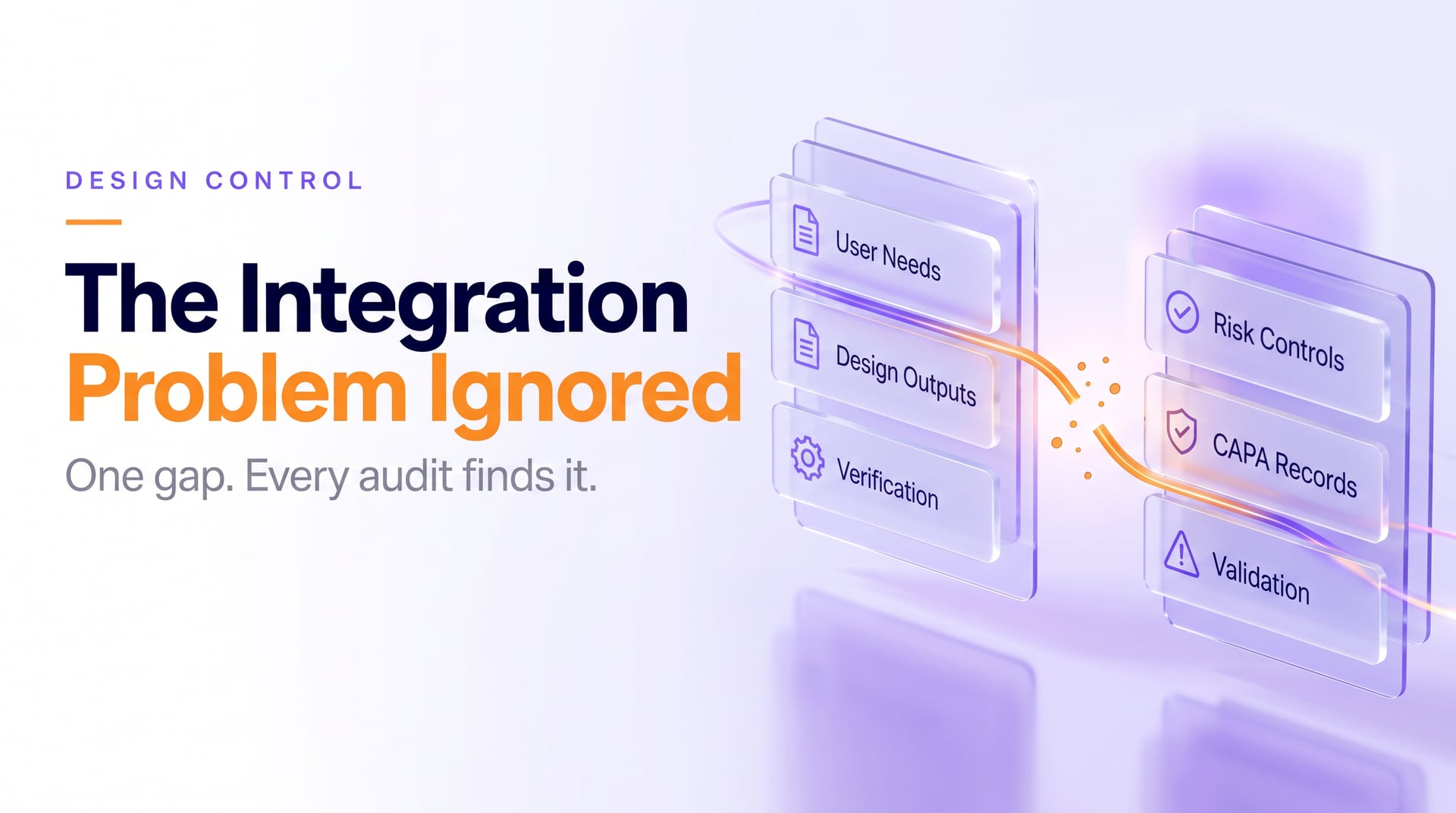
A requirement change can affect risks, test cases, defect records, verification results, and the design history. This is where a native data model and a synchronized one behave differently, so test change management against a representative engineering change from your own environment, not the vendor's sample project.
For manufacturers developing software-enabled devices, establish how source code, issue tracking, test execution, verification evidence, and software release records will be governed. Both platforms connect to engineering tools, so evaluate integration quality and native workflow depth separately.
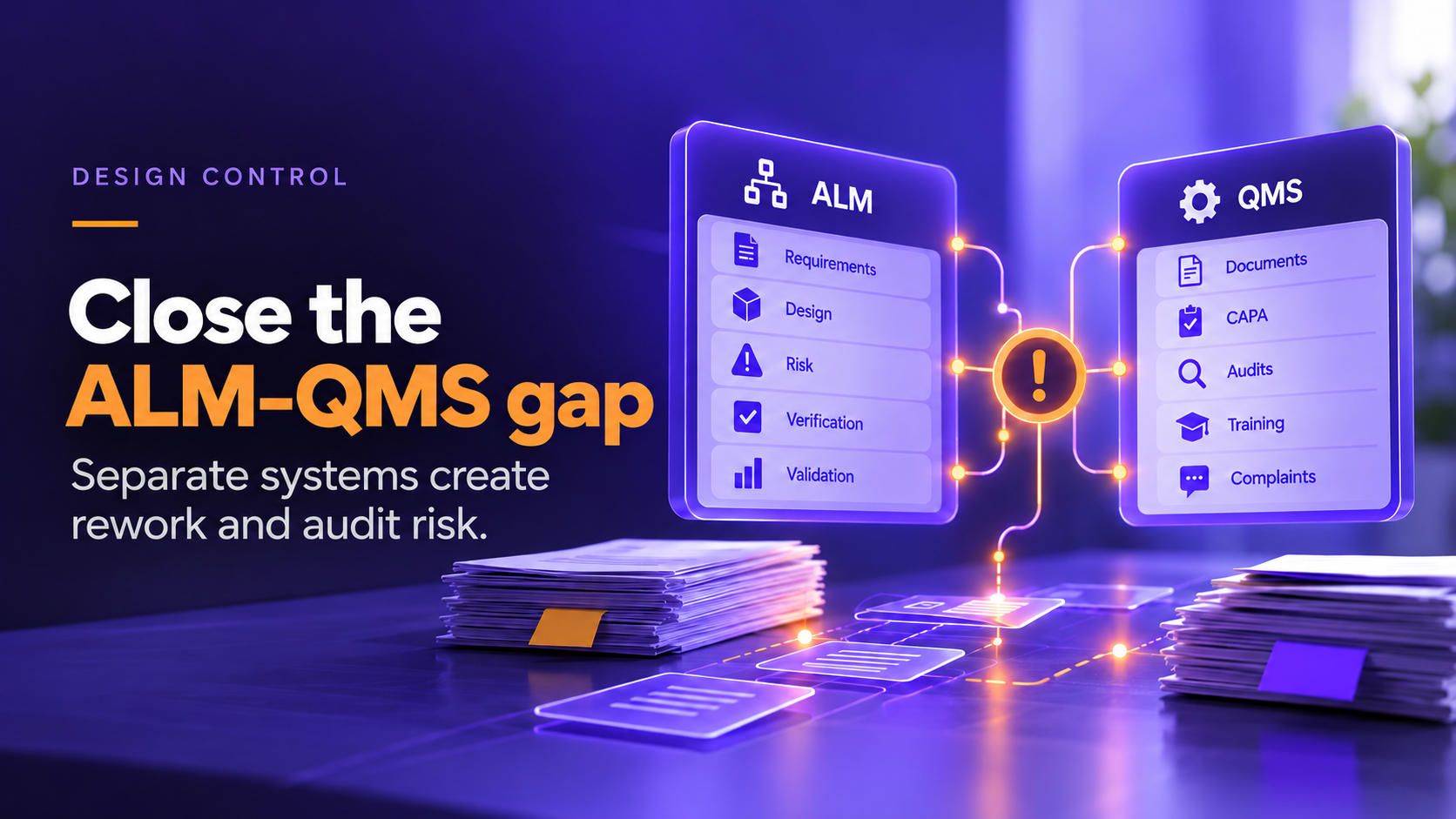
On the development side, what software teams call ALM, you manage requirements, test planning and execution, defects, and engineering changes. The QMS manages controlled documents, nonconformances, CAPA, complaints, training, and audits. In regulated device development the two overlap constantly, especially during risk reviews, verification, and controlled product changes.
FDA's Quality Management System Regulation (QMSR) took effect on February 2, 2026, and incorporates ISO 13485:2016 by reference, with FDA-specific provisions. Neither the QMSR nor ISO 13485 requires a single software platform, and you can meet these obligations with one platform or several properly managed systems. But if you're already revising SOPs for the QMSR transition, it's a sensible time to check how well your tools support them.
A meaningful demonstration should establish whether traceability is bidirectional, how changes expose potentially affected risk controls and verification evidence, how approval history is retained, and where manual intervention is still necessary.
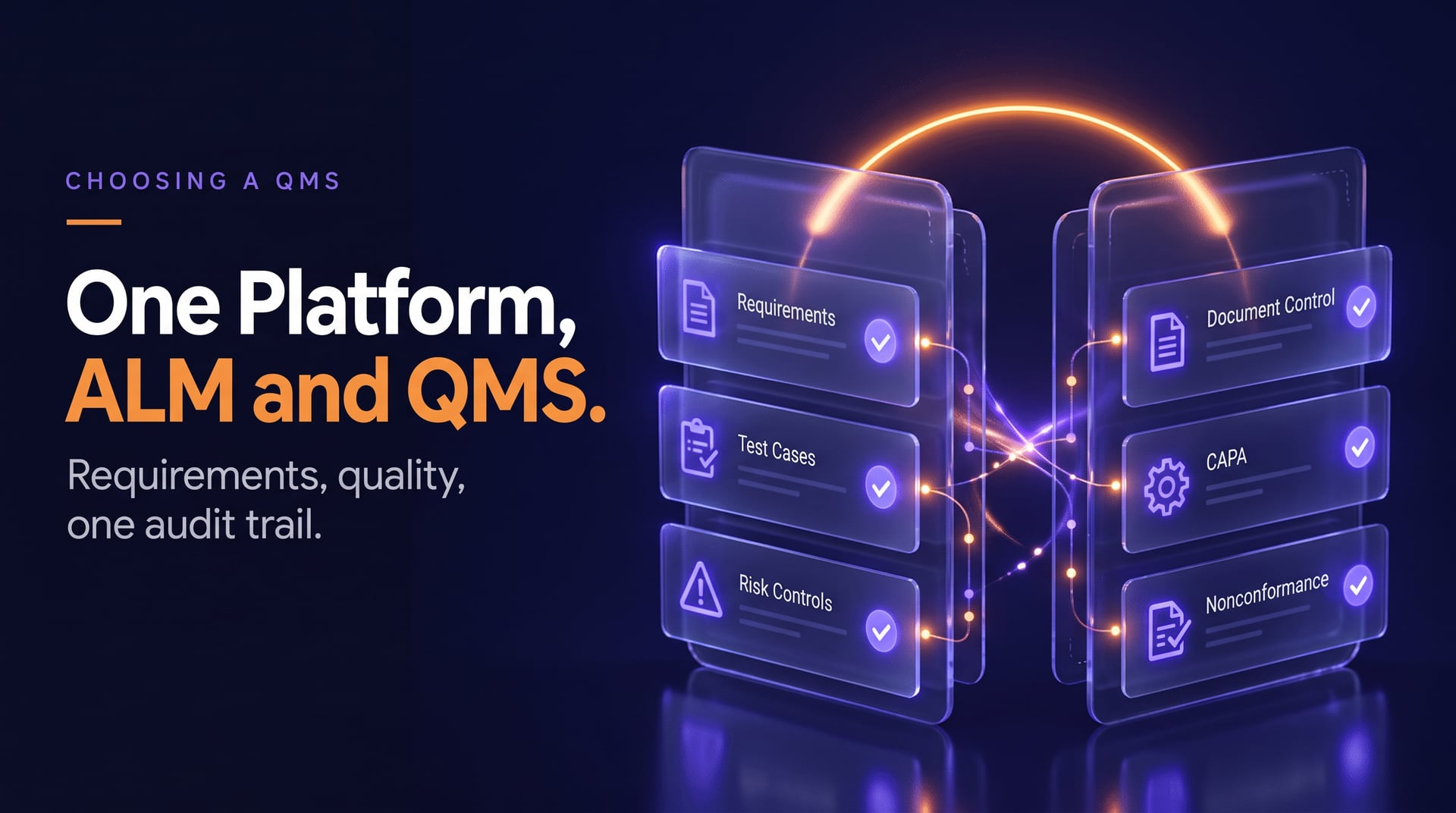
Orcanos is built for the point where product development and quality management stop being separate jobs: requirements evolve, products mature, and post-market issues feed back into design. Design controls and the QMS share one data model, and workflows are configured around your SOPs, so the same change isn't recorded twice in two systems.
Orcanos supports requirements management, ISO 14971-oriented risk records, test management, defect tracking, and engineering change processes alongside CAPA, complaints, document control, and audits. Related artifacts can be linked through a traceability model so QA can inspect the engineering context of an investigation and R&D can assess downstream quality impacts.
Consider a field complaint that raises a potential design concern. Quality documents the event, assesses its significance, and determines whether a nonconformance or CAPA process is warranted. If engineering must modify a requirement or risk control, the team can examine linked tests and change records, route approvals and preserve the controlled history. The investigation still determines whether CAPA or a design change is needed. Orcanos helps the team manage and trace the work; it doesn't make that regulatory judgment for them.
In Orcanos, quality managers configure forms, fields, access permissions, and approval workflows to match your SOPs, without writing code. It's one of the most frequent complaints in eQMS reviews across vendors: the tool forced the team to change how it works. Configurability matters even more for organizations with several product families, sites, or functions that each have their own governance.
Configurability must remain subject to appropriate change control and validation. During evaluation, ask which changes administrators can make, what validation documentation is supplied, and how controlled configuration changes are handled. Have the vendor configure a real nonconformance or ECO workflow during the demonstration.
Orcanos engineering change order workflows connect changes across documents, design controls, and quality records and support notifications, approvals, and training activities. This gives teams a concrete way to review affected records rather than assuming a design change automatically updates every approved artifact. During the demo, focus on how the system identifies affected records, routes approvals, and keeps the change history.
Adopting a connected design control and QMS platform doesn't mean replacing every engineering tool. Orcanos integrates with Jira and GitHub, so you decide which activities stay in specialist tools and which records are governed in Orcanos. In a pilot, compare integration mapping, sync behavior, permission boundaries, and what happens when a sync fails.
Covaris' published customer story describes four days of auditing within approximately a week and a half, with records managed directly in Orcanos. For Quality and Regulatory leaders, the significance is practical: controlled evidence can be accessed in the system used for daily operations, reducing dependence on last-minute document compilation.
Getting a first product through FDA is one kind of problem. A second product line, an EU MDR technical file, notified body surveillance audits, and post-market data feeding back into design are another. Each adds records that have to stay connected: a complaint that traces back to a requirement, a risk file that reflects the latest design change, a training record tied to the revised SOP.
Orcanos is built for that stage. It supports ISO 13485, EU MDR, ISO 14971, and IEC 62304 from the same connected record. Adaptix used it to get through a major European regulatory review:
“By serving as our 'single source of truth,' Orcanos eQMS seamlessly bridged the gap between our R&D, regulatory, and quality departments, enforcing compliance at every step. Their platform gave us the total confidence and data integrity needed to clear this major European regulatory hurdle efficiently.”
Martin Stofanko, Quality and Regulatory Director, Adaptix
The average Orcanos go-live time is 24 days, although actual deployment timelines depend on module scope, data migration, integrations, and validation requirements. For an executive-level comparison, request a defined implementation scope from both vendors and assess the full cost of ownership, including licensing, training, ongoing administration, and future expansion.

Greenlight Guru remains a credible choice for organizations whose quality and product-development requirements are well served by its modules, operating model and available integrations.
Orcanos is the stronger fit when Quality and R&D share the decision, native requirements and test management matter, design changes must stay traceable to quality records, your approval workflows need to follow your SOPs, or you're scaling into more product lines, EU MDR and post-market surveillance.
The final decision should be based on a demonstration of representative workflows, customer references with comparable regulatory complexity and implementation proposals that reflect the organization's actual operating requirements.
Ask both vendors: “Show us how a field complaint with a plausible design implication is investigated, connected to the relevant requirement and risk control, linked to verification evidence, and, if justified, managed through CAPA and an approved engineering change.”
Follow up with a few direct questions: Which links are created by users? What is synchronized? What alerts the team to a stale test or risk assessment? Can an auditor follow the history without exports? Can the workflow be configured to match your SOP?
If you're evaluating design controls and QMS together, book a 30-minute conversation with our team. Bring someone from Quality and someone from R&D. We'll use the time to understand your processes and traceability requirements, so any demo that follows is built around them.
Book a 30-minute conversation with Orcanos
Yes. Orcanos is a medical device platform that combines design controls (ALM) and eQMS in one data model, with workflows configured around your SOPs. Whether it's the better fit depends on your requirements, process configuration, validation needs and integration scope.
Yes. Greenlight Guru currently markets requirements, design controls, ISO 14971 risk management, software-release management and Jira/GitHub integrations. The useful comparison is how deep those functions go and whether they share one data model with your quality records.
No. These frameworks require applicable controlled processes and records, not a specific software architecture. A connected platform may reduce reconciliation work, but integrated separate systems can also meet requirements.
A recurring theme in published reviews is workflow flexibility: quality processes that don't adapt easily to a company's own SOPs. Others mention reporting and cost. Reviews aren't universal, and some describe older versions, so use them to decide what to test in a demo.
Yes. Orcanos supports ISO 13485, EU MDR, ISO 14971, IEC 62304 and FDA 21 CFR Part 11 in the same connected record, so technical documentation, risk files and post-market data stay linked as products change.
Include licensing scope, migration, validation, configuration, integrations, training, reporting, future modules and the effort needed to maintain traceability.